The Fastest Growing Businesses Don't Fix Every Problem. They Fix One.
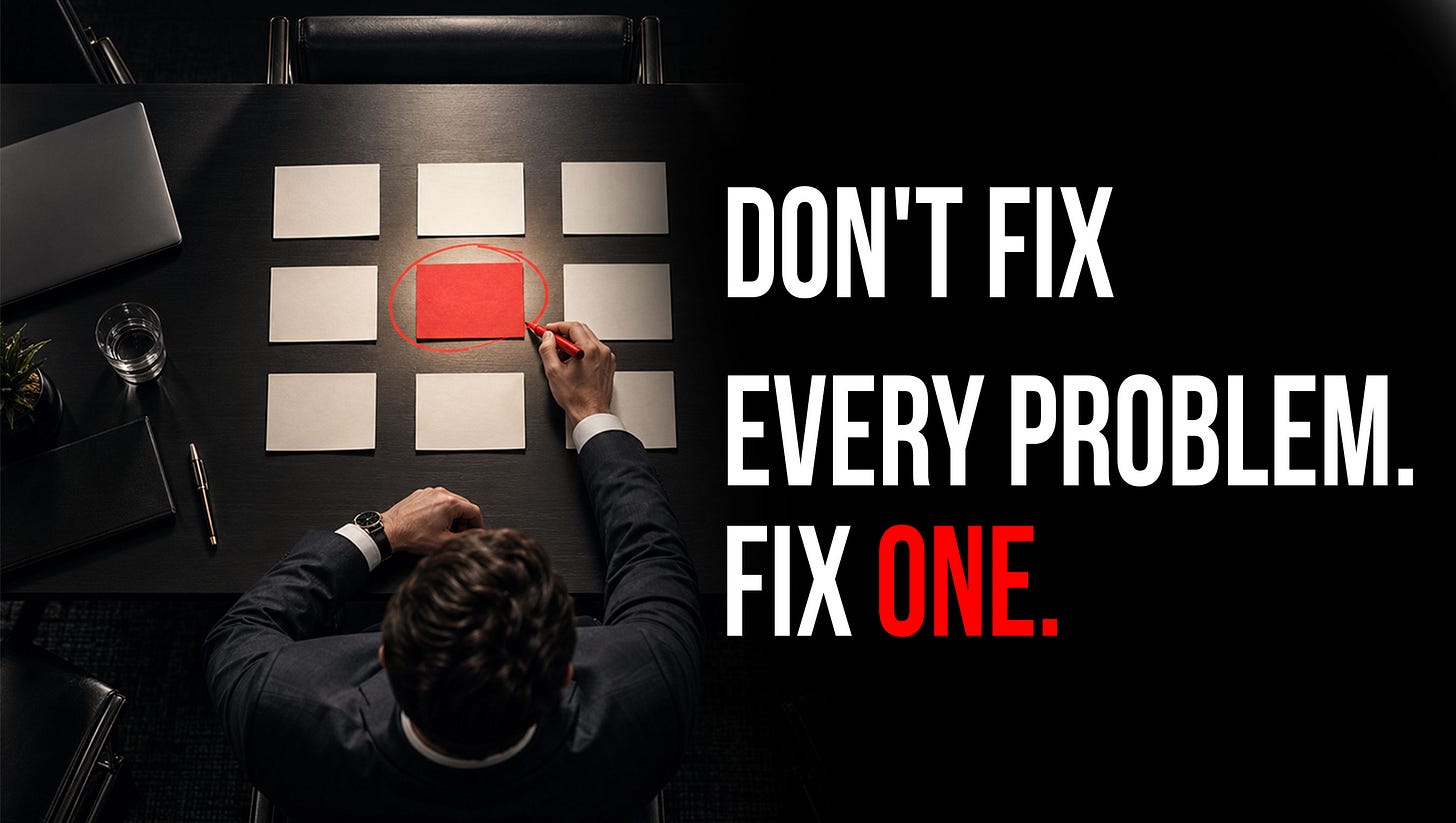
Founders come to me with a list.
Eleven things wrong with the business. Sales could be sharper, hiring is slow, the website is dated, onboarding is clumsy, reporting takes too long. Every item on it is true. They want to know what order to fix them in.
I’ve learned to ask something else. Which one of these is actually stopping you from growing?
There’s usually a long pause.
They’ve been taught that running a business means improving it from every angle. That instinct to develop feels like good leadership at first, till they learn that it’s quietly costing them.
Ten chefs, one oven
A kitchen with ten chefs and one oven doesn’t cook faster when you hire an eleventh chef. Everything still waits for the oven.
You can sharpen the knives, redesign the menu, train the staff. Dishes leave that kitchen at the speed of the oven, and nothing else.
Businesses work the same way. Most founders are ignoring the oven.
Why the wrong fix feels so good
This is what makes it hard to catch.
When you improve something that isn’t the constraint, the work is real. The team sees the difference and they’re pleased about it. Nothing in the experience tells you it was pointless.
I’ve watched a company double its marketing output while its sales team was already three weeks behind on the leads it had. Every new lead joined a longer queue. The marketing was good. The leads were good. They arrived somewhere that couldn’t process them, went cold, and got counted as a marketing problem.
The instinct at that point is to generate more leads. It usually is.
Six months later that business is measurably better in eleven ways and roughly the same size. The founder wasn’t wrong about any of the eleven problems. He was wrong about which one mattered.
You already know your bottleneck
I rarely have to help a founder find it. Push them to answer in ten seconds and the name comes out.
Which raises a harder question. If they know, why is it still there?
Because the constraint is almost always the thing they least want to touch. A person who should have gone two years ago. A price that has to rise and will cost clients. A part of the business they built themselves and don’t want to hear criticised.
That’s an appetite problem.
The other ten items on the list are a refuge from the real issue. Every hour you spend on them avoids an uncomfortable decision you have to make.
If you want one test that cuts through it, ask, if everything else doubled tomorrow, would anything change? Whatever has to move for that answer to be yes is your oven. You’ll know it immediately, and there’s a reasonable chance your stomach will drop slightly.
Why this costs more in the UAE
In many markets, a founder’s biggest constraint is external. Capital is hard to raise. Talent is hard to reach. Customers are three flights away. Regulation takes a year.
In the UAE, most of that has been removed. You can register a company in days, meet an investor and a distributor in the same week, and hire from almost anywhere on earth.
Which sounds entirely like good news, and mostly is. But it has a consequence founders here don’t expect.
If the external constraints are gone, the one holding you back is almost certainly internal. It’s in how you’ve built the thing, or in a decision you haven’t made. There’s no longer a market to blame, which is uncomfortable, and it’s also the most useful thing about building here.
And in a market moving as quickly as the UAE, that matters. Six months spent solving the wrong problem isn’t just six months lost. It’s six months in which the market kept moving without you.
Something strange happens when you fix it
Here’s the part almost nobody prepares for.
Fixing your bottleneck doesn’t remove it. It moves it.
Solve sales and delivery becomes the constraint. Solve delivery and it’s hiring. Solve hiring and it’s cash, because now you’re paying people before the revenue arrives.
Founders find this demoralising. I understand why. It feels like the problem is chasing you.
I’d argue the opposite. A business with a clear constraint is a business that is trying to grow. The constraint is the evidence. What should worry you is a business where nothing is straining at all. Because, that is a stalled company.
Final thoughts
So here’s what I’d do this week. Write the list. All of it, however long.
Ask one question: If everything else improved tomorrow, what would still stop us from growing?
That is your oven. Circle it.
Leave the other ten problems alone.
For a while, at least.
Because disciplined growth doesn’t mean fixing everything.
It means knowing what you can afford not to fix yet.