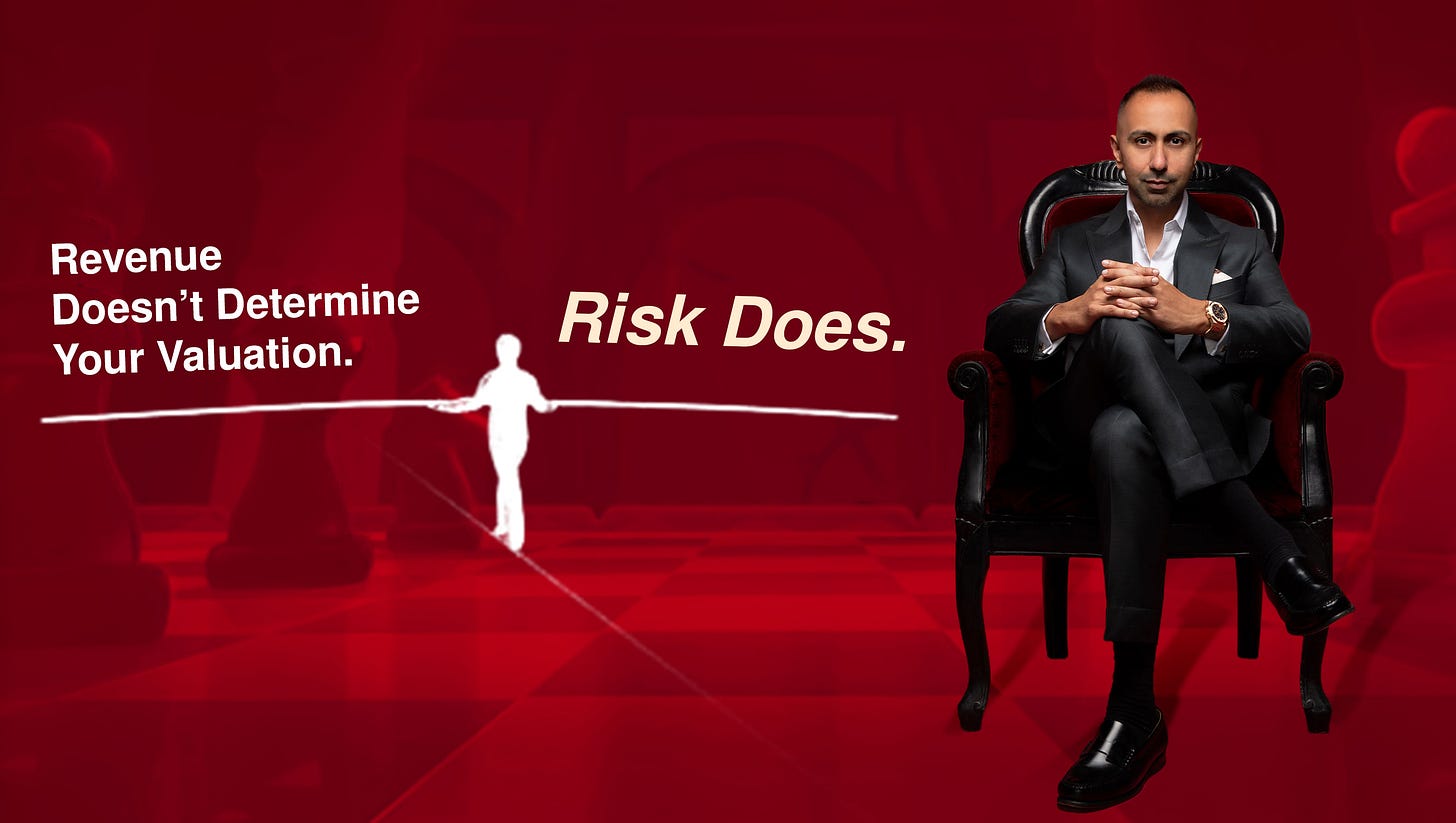
Revenue Doesn’t Determine Your Valuation. Risk Does.
Your startup might be growing fast right now.
Revenue is climbing. Customers are renewing. You have found product-market fit. From within the company it feels like momentum.
But here is something many founders in the UAE are only beginning to realise.
Two companies can have the same revenue, the same margins, and the same growth rate, yet raise money on completely different terms. One secures funding smoothly at a strong valuation with favourable interest rates. The other faces delays, tougher scrutiny, and significantly more expensive capital.
The difference is not performance.
The difference is perceived future risk.
The Real Conversation Happening In Boardrooms
Imagine you are pitching next year. The banker does not challenge your traction. Your numbers make sense. Cash flow looks healthy. Growth projections appear realistic.
Then the conversation shifts.
Suddenly, the questions are no longer about revenue. They begin asking about operational exposure.
- How dependent are you on rising energy costs?
- How resilient is your supply chain?
- Are you tracking operational efficiency across your fleet?
- If regulations tighten, will your reporting systems hold up?
These are not greenwashing questions. They are questions about underwriting risk.
Capital across the UAE is quietly repositioning itself. Abu Dhabi has committed billions towards climate-aligned investment funds. Dubai is gradually integrating ESG standards into major financial transactions. These shifts are influencing how banks and investors price capital.
If a business appears exposed to future regulation or supply chain instability, lenders rarely reject the opportunity outright. Instead, they price the risk differently.
That can mean higher interest rates on loans. Lower valuation multiples during fundraising. Additional conditions attached to financing. Slower approval timelines.
Two logistics companies can walk into the same funding meeting with identical revenue. One presents documented efficiency metrics, structured reporting systems, and clear supplier transparency.
The other says they will address those issues later. The first company appears predictable. The second appears risky. Capital almost always chooses predictability.
What Changed For One Founder
I once advised a founder whose company was profitable and growing with margins close to 30 percent. By most standards, raising capital should have been straightforward.
Yet when he began pitching regional funds, the toughest questions were not about revenue projections. They were about fleet efficiency, emissions baselines, and supply chain exposure. He had never viewed the business through that lens.
Instead of chasing growth at any cost, he focused on restructuring the operational side of the company. Efficiency data was properly documented. Supplier exposure was mapped. Reporting systems were cleaned up so institutional investors could analyse the business with greater confidence.
Nothing changed about his customers.
Nothing changed about his product.
What changed was how safe the company looked on paper.
His next funding round closed nearly forty percent faster and on significantly stronger terms. The interest rate was lower. The valuation was higher. The conditions attached to the funding were minimal.
The cost of money dropped because the perceived risk dropped.
The Shift Happening Quietly Right Now
Sustainability is no longer simply a branding exercise. It is becoming part of financial due diligence. Across the UAE capital environment today, operational discipline increasingly affects the cost of money. You do not need to become a climate activist. But you do need to understand the core question banks and institutional investors are asking before deploying serious capital.
Will this business still make financial sense five to ten years from now under tighter regulation and greater accountability?
If the answer is clearly yes, capital flows smoothly.
If the answer is uncertain, capital becomes expensive.
Your Work Tonight
If you are planning to raise capital in the next eighteen months, start preparing now.
Document your efficiency metrics. Revenue alone does not prove that a business can survive tighter margins or regulatory changes.
Map your supply chain exposure. Identify where genuine vulnerabilities exist before investors discover them themselves.
Clean up your reporting systems. Not because it satisfies compliance requirements, but because clean data allows investors to underwrite confidence.
Institutional investors are not looking for perfection. They are looking for predictability. And predictability is what capital rewards.
The Real Question
Revenue builds your company.
Risk perception determines your funding terms.
The companies that secure capital on strong terms compound faster than those chasing growth at any cost.
You can have thirty percent margins and forty percent year-over-year growth. But if an investor sees operational exposure, they will not fund you at the same price.
So here is the question I want you to consider tonight.
What is one operational weakness in your business that an investor might see as a future risk? The one issue you have been ignoring because revenue growth feels more urgent.
Because the cost of ignoring it today often becomes the cost of money tomorrow. And in a capital-constrained market, that can be the most expensive decision a founder makes.